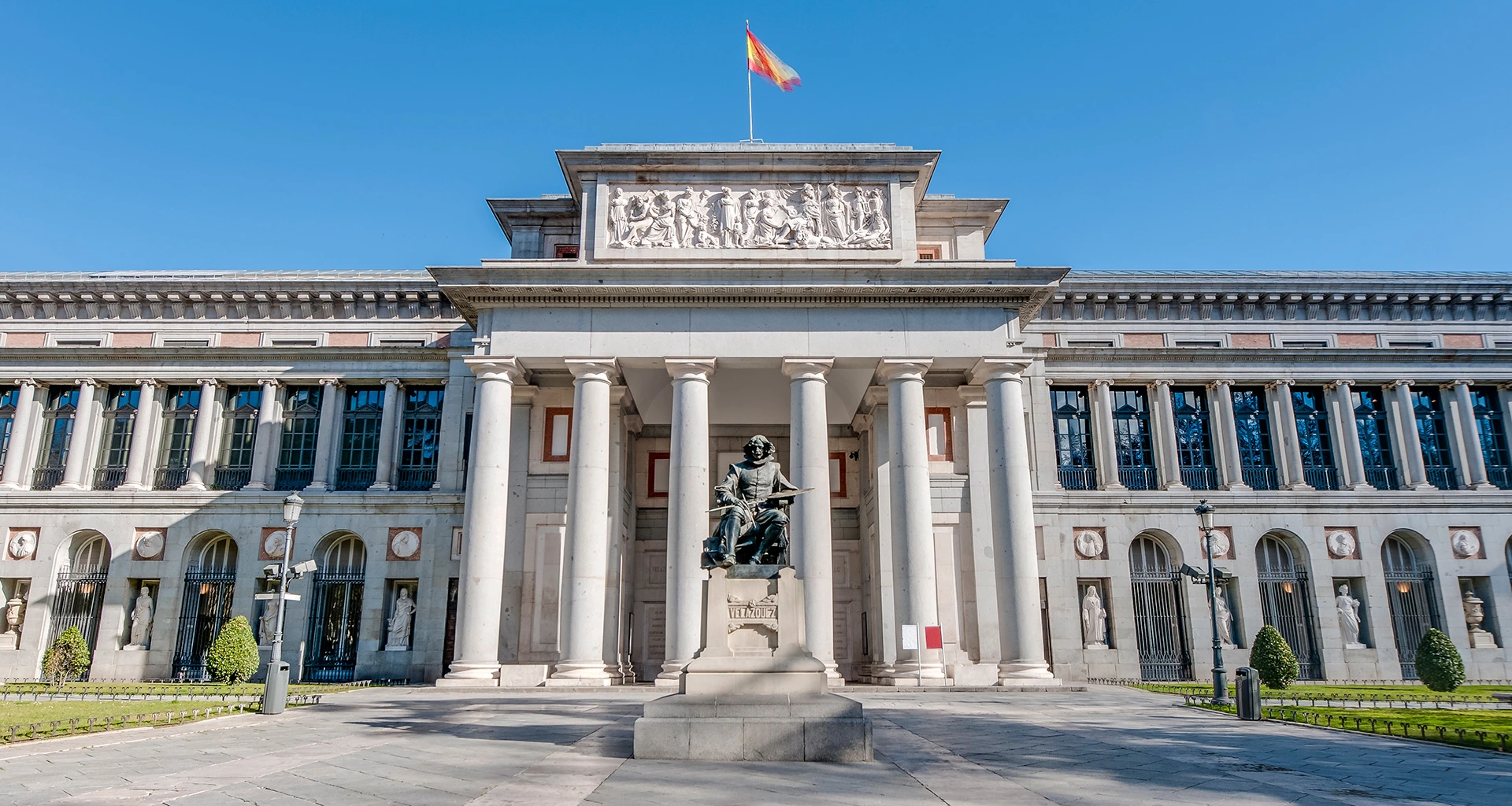
10 Must-See Masterpieces During Your Visit to the Prado Museum
Choosing only 10 must-see masterpieces in the Prado Museum is a tough challenge, especially given the international consensus that it is the art gallery with the most masterpieces per square meter. But we did it!
We have prepared an express visit to the Prado Museum with our selection of the 10 most important and representative works of its collection. Grab a pen and paper, jot them down, and book your visit to the Prado Museum skipping the lines with Panchotours and Feel the City.
1. Las Meninas – Diego Velázquez
This is one of the most visited paintings in the Prado Museum. The Family of Felipe IV, better known as Las Meninas, is the masterpiece of Spanish Golden Age painter Diego Velázquez. This painting portrays a portrait of Infanta Margarita Teresa of Spain, surrounded by her maids, "las meninas," in which we can also see the figure of the Sevillian painter Velázquez himself.
The work stands out for its originality in genre, halfway between being a portrait and representing a scene of a personal conversation. It follows the technique of pigment dilution, achieving a thinning of the pictorial surface, thus simplifying brushstrokes.
2. The Nobleman with His Hand on His Chest – El Greco
Domenikos Theotokopoulos, popularly known as El Greco, was one of the most important painters of the Renaissance. Although he was born in Greece, it was in Spain that he produced his most famous artworks. Of these masterpieces, the one that has had the greatest influence on the art world and Spanish culture is The Nobleman with His Hand on His Chest, painted between 1578 and 1580.
The work is a half-length portrait of an unknown nobleman, representing honor and integrity through its composition and symbolism. In line with the great Renaissance masters, it depicts the nobleman with a calm expression, his right hand placed on his chest as if taking an oath. Thus, El Greco exemplifies the qualities of a good Spanish nobleman or hidalgo.
3. The Three Graces – Peter Paul Rubens
Rubens was one of the most important Baroque painters of the Flemish school and the favorite painter of Felipe IV of Spain, his main patron. That is why the Prado Museum houses the largest collection of works by the painter, with a total of 90 canvases by Rubens.
Among them, we recommend you not to miss The Three Graces, a work of exceptional beauty. It stands out for its warm, vibrant, and luminous palette of colors. The subject of the work is the representation of the "Three Graces," the daughters of Jupiter symbolizing beauty, love, fertility, and sexuality. It is said that one of the figures represents Rubens' second wife, Helena Fourment.
4. The Garden of Earthly Delights – Bosch
One of the biggest attractions of the Prado Museum, and a visitor favorite, is the most famous and representative painting by Bosch: The Garden of Earthly Delights. As in many of Bosch's works, it is neither dated nor signed, although its provenance is unquestionable.
The triptych, filled with symbolic content with countless interpretations, represents the end of the last day of Creation, with sin as a common element in each of its scenes. It is one of the most fascinating and mysterious works in art history and a must-see stop during your visit to the Prado Museum.
5. The Pearl – Raphael (Rafaello Sanzio)
The Holy Family, commonly known as The Pearl, is one of the most acclaimed works of the painter Rafaello Sanzio, or Raphael, one of the most prominent artists of the Italian Renaissance. The Pearl depicts the Holy Family, baby Jesus on the lap of the Virgin Mary, accompanied by a young John the Baptist and his mother, Saint Elizabeth, with Joseph in the shadows of the painting.
The Pearl stands out for its chromatic richness and quality of its nuances, as well as the quality of the landscape: a sunset among Roman ruins. Other masterpieces by Raphael that we suggest you see in the Prado Museum, if you have time, are Portrait of a Cardinal and Madonna with the Fish.
6. Emperor Charles V at Mühlberg – Titian (Tiziano Vecellio)
This most famous portrait of Emperor Charles V is an equestrian portrait by the Italian Renaissance painter Titian, one of the greatest examples of the Venetian school, known among his contemporaries as "the sun among small stars."
The portrait commemorates Charles V's victory at the Battle of Mühlberg in 1547. It represents, through the figure of Charles V, the myth of heroic power and at the same time presents the Emperor as a "soldier of Christ." This artwork of extraordinary artistic value had a huge influence during the Baroque period. Undoubtedly, you can't miss it during your visit to the Prado Museum in Madrid.
7. Self-Portrait – Albrecht Dürer
Dürer's Self-Portrait is one of the most interesting pieces in the Prado. It is one of the most famous works by Albrecht Dürer, the most iconic artist of the German Renaissance. In it, Dürer portrays himself as a "gentiluomo," the man tasked with informing the King of the latest news, using light tones and appearing dressed in his finest attire.
Albrecht Dürer was the first Western painter to depict himself in several self-portraits he completed throughout his life. In doing so, he sought to elevate his status and present himself as more than just a mere craftsman.
8. The Naked Maja – Francisco de Goya
Of all the Goya paintings preserved in the Prado Museum, we recommend that you do not miss The Naked Maja. The Prado Museum houses the richest and most extensive collection of the renowned Spanish painter Francisco de Goya, whose work evolved from Rococo to Preromanticism, through Neoclassicism, interpreting each movement in a highly personal and original way.
The Naked Maja is a portrait of an extraordinarily beautiful young woman who, despite not being a mythological nude, has been associated with the figure of Venus. The portrait is influenced by Neoclassical aesthetics, although Goya transcends it and shows much bolder elements for his time, such as the model's satisfied smile. Additionally, it is the first known artwork to depict female pubic hair. Although it is uncertain, it is said that the model could have been the XIII Duchess of Alba, Cayetana.
Other must-see works by Goya that you can admire in the Prado are The Family of Charles IV and The Third of May 1808 in Madrid.
9. Artemisia – Rembrandt
Judith at the Banquet of Holofernes, formerly known as Artemisia, is one of the greatest masterpieces by Dutch artist Rembrandt, one of the greatest masters of Baroque painting. Rembrandt completed the piece Artemisia in 1634, in oil on canvas. According to recent research, the title Artemisia is incorrect, as it actually represents a biblical scene: Judith at the Banquet of Holofernes.
The painting depicts a young woman dressed in luxurious clothing and jewelry. It is believed that Rembrandt's model was his own wife, Saskia van Uylenburgh, whom he had married in the same year the work was dated. It has belonged to the Royal Collection since 1768.
10. The Triumph of Death – Brueghel
The Triumph of Death is one of the most famous works by Flemish painter Brueghel and our last recommendation of the most important works housed in the Prado Museum in Madrid. The work, dating from 1562, was acquired by the Spanish Royal Family in the 18th century.
The Triumph of Death impresses with its severity, a faithful and macabre depiction of death, in what could be a battlefield. It represents an apocalyptic vision of death at a time when its figure was exalted to the point of being considered a matter of pride to die in war.